
Key Takeaway
AI is about to answer most patient questions before they even open your website. So just having information isn’t enough anymore. Patients want to feel understood. They want clear, simple answers and a bit of reassurance. If your website gives them that, they won’t go looking elsewhere.
That’s the new SEO —
not Search Engine Optimization, but Search Experience Optimization.
Let’s begin with a simple truth.
As doctors, you’re used to building trust in person.
You listen, explain, reassure—and patients feel comfortable.
But online, things are different.
Now you’re up against AI that answers instantly, sounds confident, and gives neat explanations—even when it’s not fully right.
Think about this:
A patient types, “Why do I feel tired all the time?”
In seconds, AI gives a clear, confident answer.
If your clinic’s website isn’t part of that answer—or your content doesn’t explain it in a simple, human way—you’ve already lost her. Not to another doctor, but to the screen.
That’s the reality now:
The patient journey is getting shorter.
And if you’re not showing up there, you’re easy to miss.
Yet, here lies the profound paradox
Even though patients are leaning more on AI summaries, they still want real human expertise more than ever.
People are tired of the same copy-paste medical content.
They’re looking for something that feels real—clear, experienced, and safe.
So the question isn’t:
“How do we beat AI?”
It’s more like:
“How do we create content that’s so honest, so helpful, and so caring that—even if AI sums it up—the patient still wants to come to us?”
The Unseen Hurdles: Why Patients Leave Your Website
Through countless digital consultations and audits for doctors across Bangladesh, we’ve uncovered a crucial insight: patients often abandon a website not because of technical SEO failures, but due to three distinct emotional disconnects. These are the moments where human psychology, not algorithms, dictates their departure.
It usually happens in three emotional stages:
- 1. The “Okay… I understand” moment
Take an example like stomach pain after eating.
A patient reads: “Acidity can cause bloating and discomfort after meals.”
They get it. It makes sense.
But then there’s a pause—
“Okay… so maybe it’s acidity.”
And the emotional connection drops right there.
- 2. The “But is this happening to me?” moment
Now they start relating it to their own life.
“I feel this almost every day after rice or spicy food… is that normal or something serious?”
They’re looking for something more specific—like:
“If bloating happens regularly after meals and feels tight or heavy, it may need medical attention.”
When they don’t see that kind of clarity, uncertainty builds—and they leave, still a bit worried.
- 3. The “So what should I do now?” moment
Now it’s no longer just information—it’s anxiety.
“Should I take medicine? Change my diet? Or see a doctor?”
But the page just ends with general facts. No reassurance. No direction. No next step.
So they close it, still carrying that confusion.
And that’s the real gap.
Not missing keywords—but missing empathy, real-life context, and gentle guidance that feels human. This isn’t a failure of keywords; it’s a profound failure of empathy and thoughtful structure. The goal isn’t just to inform, but to gently lead them from concern to confidence, and ultimately, to action.
Making Your Doctor’s Website Truly Irresistible: Beyond the Click
Let’s think like a patient, not a marketer.
A patient doesn’t wake up wanting to “read a blog.”
They just want to feel understood—and a little less worried than before.
SEO can help your website show up on Google, and even get picked up by AI tools. That’s the first step.
But trust is something else.
If you want patients to actually stay, believe you, and come back to you, your content has to go deeper. It needs to answer their real questions—not just the obvious ones, but the messy, unspoken ones too.
Because at the end of the day, if patients start trusting you as their source, they won’t keep searching on random AI tools or websites. They’ll come straight to you. And that’s where real conversions happen.
So the goal is simple:
not just to be visible—but to be the place people choose to return to.
Imagine this: if patients come to trust your website as their ultimate, most reliable source of health information – a place that truly ‘gets’ them – they will eventually bypass generic AI searches. They will come directly to your site for answers, bypassing the noise and allowing you to build that crucial relationship. This direct engagement is where real conversions, and real care, truly begin.
Here’s how we meticulously engineer that powerful, trust-building experience:
1. Build Around Patient Journeys, Not Disconnected Topics
Instead of writing separate blogs like “thyroid symptoms,” “thyroid causes,” “thyroid treatment,” think in terms of what the patient is actually going through.
Create one clear starting point:
“I’ve just been told I have thyroid — what now?”
Then walk them through what they’re really feeling:
Why this is happening (in simple language)
What symptoms actually mean in daily life
How medication works and what to expect
Weight changes and energy issues
Emotional stress and fear of lifelong treatment
And connect everything smoothly.
No dead ends, no jumping around.
So the patient doesn’t go back to Google.
They just keep moving forward on your site.
2. Write Like You’re Speaking to a Patient Sitting in Your Clinic
Think about explaining kidney stones to a patient sitting right in front of you.
You wouldn’t say:
“Renal calculi are solid concretions formed in the urinary tract.”
You’d say something like:
“Sometimes minerals in your urine stick together and form small stones—that’s what causes that severe back or side pain.”
That’s the tone your website needs.
Simple, calm, and real.
Not fancy. Not robotic. Just human.
Because patients don’t trust perfect language—they trust familiar language
3. Anticipate Their Next Question, Before They Even Ask
When we write for doctors at GrowthPixel, we always think one step ahead:
“What will the patient worry about next?”
For example:
If you write: “Migraine is a common neurological condition.”
The next thought in their head is immediate:
“But why do I keep getting it again and again?”
So instead of waiting for them to wonder, you answer it right there:
“Many migraines are triggered by stress, sleep changes, or even skipped meals.”
That small flow—question followed by reassurance—creates comfort.
And comfort keeps people reading.
4. Seamlessly Blend Logic with Emotion
Patients don’t just want to know what it is.
They want to know why it feels like this.
So your content should carry both:
Logic: clear medical explanation
Emotion: recognition of what they’re experiencing
For example:
“If you’ve been feeling frequent dizziness, it’s not just ‘low energy’—it can affect your confidence, focus, and even daily routine.”
That one line doesn’t just explain.
It understands.
5. Speak the Patient’s Language
We don’t ignore AI or Google—we just don’t let them control the tone.
Structure your content so systems can read it:
Questions in headings that match real searches
FAQs for common doubts
Clear summaries and key points
But keep the voice human.
Because the truth is simple:
Search engines reward clarity.
Patients reward care.
You need both to win.
6. Transforming Pages into Stories
Instead of writing something like “Recovery after appendicitis surgery,” make it feel lived-in:
“Most patients are able to sit up and move slowly within a day after surgery.
By the end of the first week, daily activities feel much easier.
There’s discomfort, yes—but the worry usually reduces faster than expected.”
You’re not just listing recovery facts.
You’re showing a journey they can emotionally picture.
And that’s what makes them stay.
The “Magic” of Doing It Right
When a doctor’s website is written and structured like this, something important starts to happen:
- Google starts paying attention.
The content becomes more likely to appear in “People Also Ask” and AI-generated summaries because it is clear, well-organized, and complete.
- AI starts referencing it.
Over time, AI systems begin to treat the site as a reliable source worth citing.
- Patients stay longer.
People spend more time reading, bounce rates go down, and they actually engage with the content.
- Conversions feel natural.
Instead of feeling like a pitch, the information feels helpful and reassuring.
At this point, the content stops acting like marketing and starts functioning like care delivered at scale.
Redefining SEO for the Modern Doctor
At Medibyte, we call this:
“Search Experience Optimisation.”
It’s not just about ranking higher.
It’s about being the most useful, trusted answer when someone finds you.
In the future, success won’t go to the sites that appear first.
It will go to the ones that respond best — with clarity, empathy, and real expertise.
The Ultimate Litmus Test
When a patient lands on your page, what is their first thought?
- “I found an answer.”
- “I found my doctor.”
If you can achieve the second, you’ve done more than just win a click—you’ve won the zero-click era by building a relationship before the first appointment is even booked.
Key Actionables (for doctors reading this)
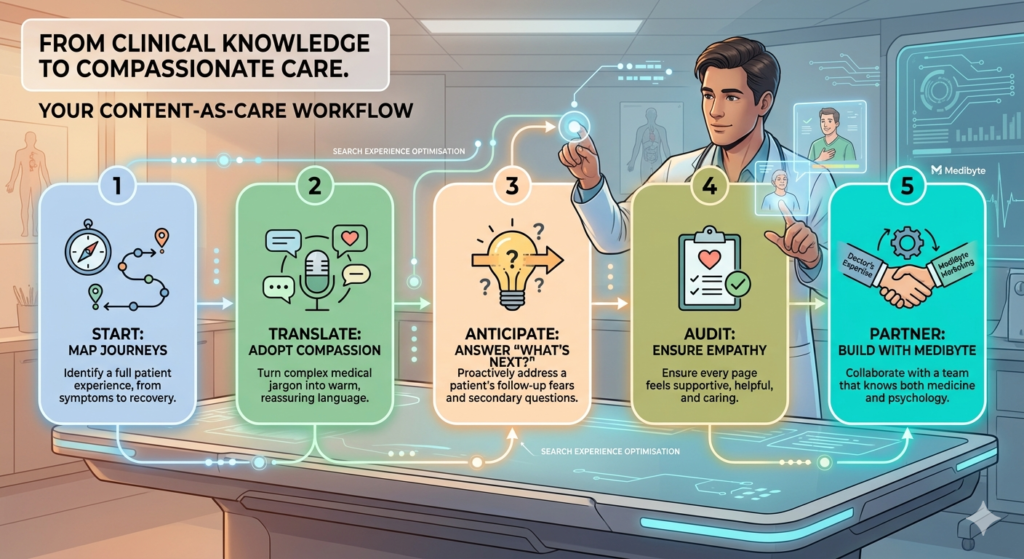
Build your blog strategy around the patient journey, not isolated topics.
- Use conversational, compassionate language — the way you speak to patients in person.
- Always anticipate the next question and answer it before it’s asked.
- Design your website to feel like a continuous experience of care, not just information.
- Work with a marketing partner who understands both medicine and psychology — that’s where Medibyte comes in.
Final Word
AI can summarise data.
But it cannot summarise trust.
Trust is built through voice, empathy, and complete, thoughtful answers — and that is something only you can create.
That’s the Medibyte way.
Because your words don’t just inform — they help people feel understood.